 |
 |
 |
 |
 |
 |
Home | Site Map | Contact |




|
|
Tetra has created thousands of projects over the years for people from coast to coast across Canada and the United States. Each project is a personal triumph. Each enables an individual to overcome a barrier, achieve more each day, and live with greater dignity and independence.
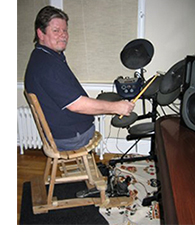 Charlie Quinn ~
 “People would say, ‘Sit at the drums and play something,’ but you can’t get a beat without the hi-hat and bass drum. It would happen at weddings, and I would wish I had a set of drums I could play.”
Charlie Quinn, the son of a professional drummer, began lessons when he was 10. A gifted athlete, making a name for himself as a minor hockey player, he seemed to have it all.
“I got hurt when I was 22, working on the railroad,” he recalls. “I fell under a train on the job and lost my legs and a couple of fingers on my left hand.”
Charlie continued his love of life, music and adventure – playing for the Vancouver Cablecars wheelchair basketball team alongside Terry Fox and Rick Hansen – but figured that drumming would remain in the past. Without being able to operate foot pedals, he could not use hi-hats and bass drum.
“My best friend has a recording studio in his basement. I found it so interesting that I would go in and record songs using a midi-drum, programmed through a keyboard.
“I got so sick of using a keyboard I thought there had to be a way of playing drums again, so I bought myself a set.”
Around this time he heard of Tetra Halifax. Volunteer Lorne Vaasjo was appointed to turn Charlie’s dream into reality. He initially considered using electronic sensors, but scrapped that in favour of building pedals into a chair, which would give a greater feeling of feedback.
“It didn’t need fancy electronics,” says Lorne. “I figured I’d make a seat. I started the first chair at 7 p.m. one evening, and left at 4:30 a.m. He was playing after I went.”
The project required many more modifications, including molding cups to hold Quinn’s stumps, spring-loaded pedals to enable him to play faster and gel padding to make the whole thing more comfortable.
Charlie Quinn is delighted and amazed that Lorne Vaasjo would go to such lengths.
“I got sick of not drumming, so this means a great deal to me,” Charlie says. “Lorne went to town. He did a great job. People come in and marvel at that chair.
“He came up with the idea for it, and worked very hard on it. He comes round for four and five hours at a time to work on it, and it just keeps getting better and better.”
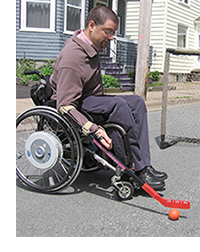 Kevin Murphy ~
“I just wanted to go outside and play with my kids. But I knew modifications to the hockey equipment would be essential for me.”
Father-of-two, Kevin Murphy, who became quadriplegic in a hockey accident 22 years ago, coaches and does whatever he can to share his passion for the sport. But what he really wanted was to play street hockey with his own kids.
“Normal hockey sticks were too long and heavy, they didn’t let me balance and manoeuvre properly in my wheelchair,” describes Kevin.
“I discovered that a child’s ball hockey stick was perfect for my needs. The only problem was that I had to have someone duct tape it to my arm every time I wanted to play, and then remove it afterwards. Tetra had found solutions for me before, so I thought they could help me again.”
Tetra Halifax volunteer James Peake, then an 18-year-old commerce student, who started out volunteering on graphic design projects, came up with the device: a modified child’s ball hockey stick with two Velcro straps, one at the elbow and one at the wrist. A loop added near the middle of the stick enables Kevin to put on and remove the hockey sticks independently.
“These simple changes have made a huge difference to me,” says Kevin. “Now I can grab my hockey stick and go play outside just as easily as any other parent in my neighbourhood.”
After repeatedly utilizing the resources of Tetra and being an active member in his community, Kevin decided to become a member of Tetra Halifax’s board of directors.
“Tetra has improved my quality of life, and I think it’s important to support such a useful organization. People with disabilities, especially the newly disabled, know what they want – but often don’t know if it’s available or are unsure of how to create it. Tetra helps enormously by simply connecting the client to a person with a creative mind and common sense.”
As James and Kevin both know, sometimes the simplest modifications can be the most effective.
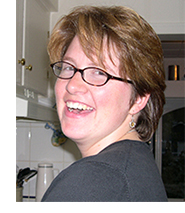 Shara Gutsche ~
“Working gives me independence and self-esteem. I feel good about working. People with disabilities have a lot to offer.”
Shara Gutsche, of Vancouver, British Columbia, knows how much difference a Tetra project can make and how seemingly small projects can have tremendous results.
Struck by a drunk driver while on a school visit to Bellingham, Washington, in January 1990, Shara suffered a brain injury, which means she has limited vision and only the use of her left arm.
Tetra volunteer Gregg Harris constructed a relatively minor workplace modification to enable Shara to work in a company that rents two-way radios to the movie industry. The company is Signal Systems of Vancouver.
Gregg’s project, a wooden cradle with a clamp to hold each radio in place, enables Shara to check and clean each unit. She also handles inventory.
“Being able to work is very important to me,” explains Shara. “Clearly, the device Gregg made for me is very helpful.”
Shara works one or two days a week, according to demand.
Gregg, a Tetra volunteer for more than a decade, is delighted that this project is so useful – his reward, he said, comes from knowing he has made a difference to the quality of someone’s life.
“This was something that intrigued me,” he recalls. “It was a bit challenging, to arrange it so someone could work on radios, using just one hand. There are so many jobs out there that can be done by people with disabilities.”
Gregg Harris, whose engineering career included working on Canada’s legendary Avro Arrow project and five years working for NASA on the Apollo project, said Tetra solutions are often deceptively simple – although it helps that he has “learned to think in three dimensions.”
Art Jonker of Vancouver, who was paralyzed from the neck down in a motorbike accident in 1997, has become an accomplished mouth-painter thanks, in part, to the work of Tetra’s Gregg Harris.
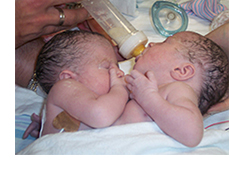 Mandy Bailey ~
“The car seat has made a huge difference. What they came up with was fantastic, and doing it just for us was so delightful.”
Mandy Bailey turned to the Tetra Society to create a car seat that would enable her to safely transport her conjoined twins.
Emma and Taylor Bailey were born September 20, 2006, conjoined from clavicle to sternum – sharing a chest cavity, heart and a liver. Parents Mandy and Tor, who live near Phoenix, Arizona, were told to expect every moment with the newborns to be the last as the girls share a single ventricle heart – one of the heart’s pumping chambers does not function.
“On the day the girls were born, we were so thrilled to get to that point,” says Mandy. “We had been told over and over that they might not survive birth.
“When they were one-year old, their cardiologist told us that babies with a single ventricle heart are not expected to live beyond six months. Having two babies on a single, abnormal heart, who are growing, is breaking all the rules.”
The problem was driving the girls to their frequent medical appointments, using a metal-framed basinet, wrapped in a seatbelt. “From six months they did not fit in it. They were squashed and angry. Our cardiologist is an hour-and-a-half away. Car rides were miserable.”
Tetra’s Salt Lake City chapter, made up of volunteers from Autonomous Solutions Inc, handled the project. Coordinator Kent Remund explained that the girls’ parents sought him out and made a brief visit to discuss details.
Due to limited neck strength, the family wanted a design that involved the girls lying down, explains Kent. He took measurements of the girls and created prototypes to show the family various alternatives. The hard work was in the planning, to find a secure, safe and comfortable solution.
“We ended up using a type of ABS plastic that is used for bicycle helmets. We spent a long time creating it, although when it was finished it is a very simple contraption – a flat piece of plastic with sides that come up, with slots in a few different places for straps.
“I offered to make them another for when they are stronger, that will allow them to sit in the car.”
That will likely be the next step, says Mandy. She adds that the family has three “absolutely major” items of adaptive equipment: a walker, stroller, and the Tetra car seat. The former allows them to move around the home, the other two enable trips outside.
For more info on Emma and Taylor see the family’s blog.